Low Water Pressure in Your House? Causes, Fixes, and When to Worry
Few things are as quietly maddening as low water pressure in your house. The shower dribbles, the washing machine takes forever to fill, and running two fixtures at once turns both into a trickle. The good news: most causes of low water pressure in a house are cheap to diagnose and many are fixable in an afternoon. The bad news: a few of them — hidden leaks, failing pipes — get more expensive the longer you wait. This guide walks you through the causes from easiest to most serious, shows you how to measure your pressure with a $10 gauge, and explains the one symptom that should make any Texas homeowner act fast.
Why Is My Water Pressure Low? Start With the Easy Stuff
Before you call anyone, work through this checklist in order. It’s arranged from “five-minute fix” to “you need a licensed plumber,” and in our experience roughly half of pressure complaints get solved in the first three steps.
1. Clogged aerators and showerheads. Unscrew the aerator on the affected faucet and look inside. In the northeast San Antonio metro — Schertz, Cibolo, Universal City, Garden Ridge — municipal water routinely tests at 14–15+ grains per gallon of hardness, some of the hardest in the country. That mineral load crusts up aerator screens in months, not years. Soak the parts in white vinegar for 30 minutes, scrub, and reinstall.
2. A partially closed shutoff valve. Check the main shutoff at the house and the valves under sinks. Valves get bumped, or get left half-open after other work. Open them fully.
3. Water softener problems or bypass. If your softener’s resin bed is fouled or its internal screens are clogged, it can choke flow to the whole house. Put the softener in bypass mode for an hour. If pressure improves noticeably, the softener — not your plumbing — is the bottleneck. Service or replace it.
4. A failing pressure-reducing valve (PRV). Most homes in our area have a bell-shaped PRV on the main line near where it enters the house. PRVs typically last 10–15 years. When they fail, they can fail low (weak pressure everywhere) or fail high (banging pipes, dripping relief valves). Replacement runs about $250–$550 installed in the San Antonio metro — one of the best-value fixes in plumbing.
5. Sediment in the water heater. If only your hot water is weak, hard-water scale in the tank or a partially clogged heater shutoff valve is the likely culprit. Flushing the tank may help; a heavily scaled 10-year-old tank may be near the end of its life.
6. A hidden leak. If pressure dropped and your water bill crept up, water may be escaping somewhere you can’t see — under the slab, in a wall, or in the yard between the meter and the house. Professional leak detection can pinpoint it without tearing anything open. More on this below, because in Texas this one deserves special attention.
7. Corroded galvanized steel pipes. Homes built before roughly 1975 often have galvanized supply lines. These pipes rust from the inside out, and the corrosion narrows the pipe’s interior diameter year after year — imagine a hardened artery. No valve adjustment fixes this. The long-term answer is repiping with PEX or copper, which permanently restores full flow.
How to Test Your Water Pressure With a $10 Gauge
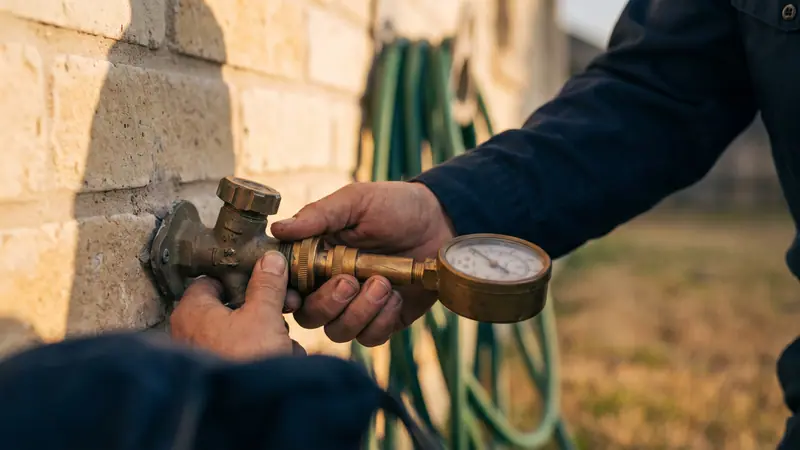
You don’t need a plumber to get a real number. Any hardware store sells a hose-thread pressure gauge for about $10–$15.
- Screw the gauge onto an outdoor hose bib (spigot).
- Make sure no water is running anywhere in the house — no ice maker, no irrigation, no laundry.
- Open the bib fully and read the gauge.
Here’s how to interpret the reading:
- 40–60 psi: Normal and healthy. Most fixtures are designed for this range.
- 60–80 psi: Acceptable, but on the high side. Code caps residential pressure at 80 psi.
- Below 40 psi: Genuinely low. If the city supply is fine (ask a neighbor to test theirs), suspect your PRV, softener, or pipes.
- Above 80 psi: Too high — this stresses supply lines, water heaters, and appliance hoses and is a leading cause of future leaks. Your PRV needs adjustment or replacement.
Test twice: once at midday and once during the morning rush (6–8 a.m.). A big difference between the two points to supply-side or shared-line issues rather than something inside your home.
Whole-House vs. Single-Fixture: Narrowing Down the Cause
Where the pressure is low tells you a lot about why it’s low. Use this table to narrow the field before you spend a dime.
| Symptom pattern | Most likely causes | Typical fix |
|---|---|---|
| One faucet or shower only | Clogged aerator, scaled showerhead, fouled fixture cartridge | Vinegar soak or cartridge swap, $0–$50 |
| Hot water only, house-wide | Water heater sediment, failing heater shutoff valve | Tank flush or valve/heater service |
| Cold and hot, whole house, gradual decline | Failing PRV, fouled softener, corroded galvanized pipes | PRV replacement, softener service, or repipe |
| Whole house, only when 2+ fixtures run | Undersized or partially blocked supply line, galvanized pipe corrosion | Pipe evaluation; often repiping |
| Whole house, sudden drop | Main line leak, slab leak, city supply issue, PRV failure | Check with neighbors, then call for leak detection |
| Low pressure plus higher water bill | Hidden leak (slab, wall, or yard line) | Professional leak detection — act quickly |
The pattern that deserves the least patience is the last two rows. Gradual decline usually means aging equipment. A sudden change means something broke.
Sudden Low Water Pressure? In Texas, Think Slab Leak
Here’s the angle that national plumbing articles miss. Nearly every home in the San Antonio metro is built slab-on-grade — your water lines run under or through a concrete slab sitting on expansive Blackland clay soil. That clay swells when it rains and shrinks hard in drought, flexing the slab and stressing the pipes beneath it season after season. Add our aggressive hard water eating at copper from the inside, plus freeze events like Winter Storm Uri in February 2021 and the January 2026 arctic outbreak that stressed thousands of local lines, and you have the recipe for a slab leak.
A pinhole leak under the slab bleeds off pressure before water ever reaches your fixtures. Classic companion symptoms: warm spots on the floor, a water meter that spins with everything off, the faint sound of running water, or an unexplained jump in your bill. If sudden low water pressure shows up alongside any of those, don’t wait — water under a foundation gets more destructive (and more expensive) every week. Electronic leak detection can locate the break within inches, and modern slab leak repair often means a targeted reroute rather than jackhammering your floors.
When to Call a Plumber
Call in a pro when:
- Your gauge reads under 40 psi and the easy fixes above didn’t move the number
- Pressure dropped suddenly rather than gradually
- Low pressure comes with a rising bill, warm floor spots, or running-water sounds
- Your home still has galvanized supply lines
- Your PRV is 10+ years old and pressure is unstable
Expect a diagnostic visit to run $50–$150 in the San Antonio metro, often credited toward the repair. Compare that with the cost of months of wasted water — or a foundation repair — and early diagnosis is the cheapest option on the table.
Need help in the San Antonio area?
If you’re fighting low water pressure in your house anywhere in the northeast San Antonio metro — Schertz, Cibolo, Universal City, New Braunfels, and surrounding communities — Hill Country Plumbing Pros can find the cause and fix it right the first time. We test, we diagnose, and we give you a straight answer before any work begins. Call us at (210) 555-0199 or learn more about our Leak Detection in San Antonio service.