Whole House Repipe in San Antonio — PEX Repiping Done Right
Second slab leak in three years? Rusty water from galvanized pipe? At some point patching stops making sense. A whole house repipe replaces the failing system once — and ends the cycle for good.
There are three houses in the NE San Antonio metro that eventually face this decision. The slab-leak house: copper lines under a slab-on-grade foundation, flexed and abraded for decades by expansive Blackland clay soil that swells and shrinks with every wet-dry cycle, springing leak after leak in new spots. The galvanized house: pre-1970s steel pipe rusted shut from the inside, delivering brown water at half pressure. And the polybutylene house: 1980s Qest gray pipe with fittings that fail without warning — a material so unreliable it triggered a national class-action settlement. Hill Country Plumbing Pros repipes all three across Schertz, Universal City, Converse, New Braunfels, Seguin, and beyond.
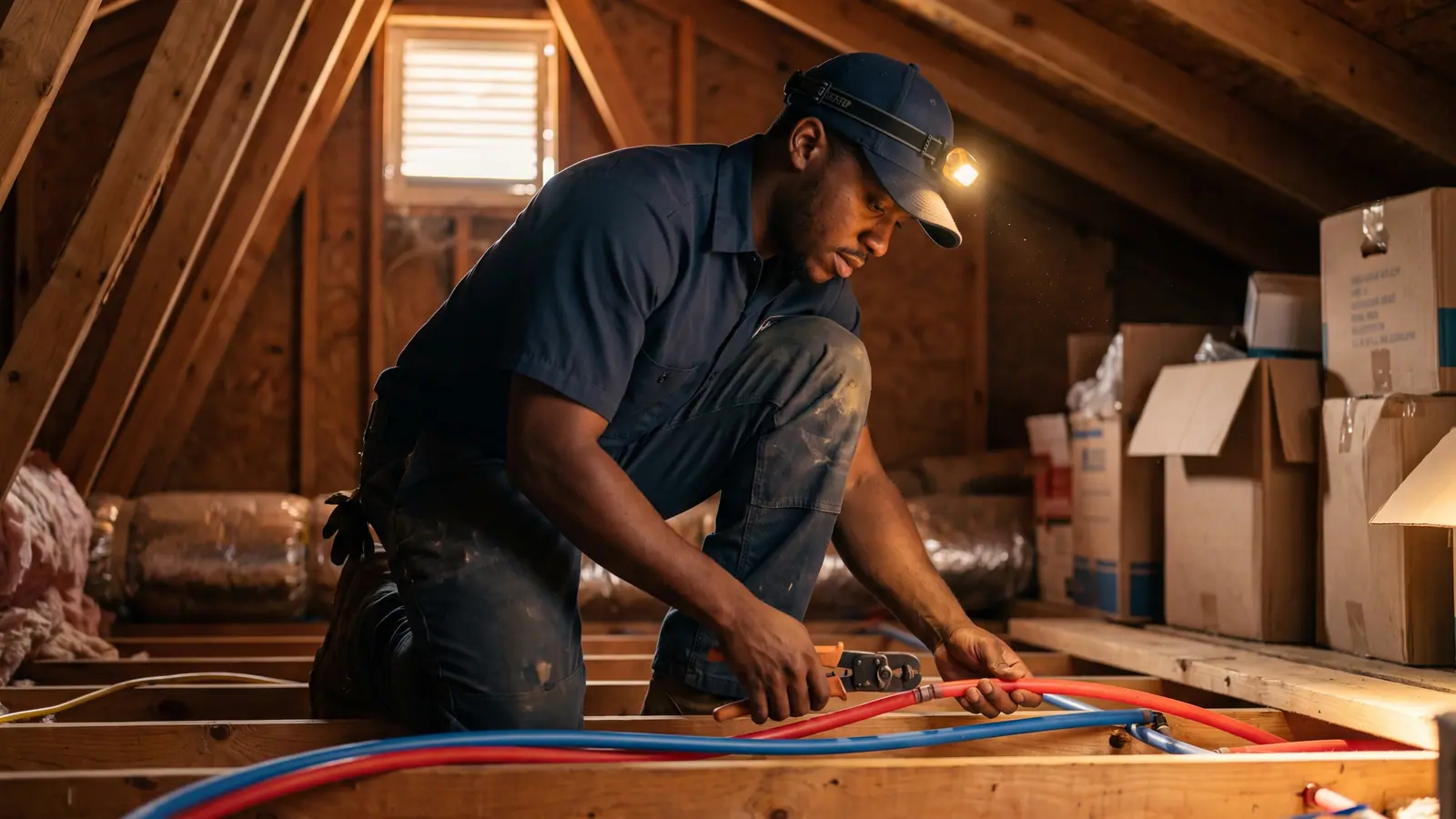
Our standard approach is a copper to PEX repipe rerouted overhead: abandon the under-slab lines entirely and run new PEX-A through the attic, dropping down inside walls to each fixture. PEX-A is the right material for this soil and this climate — it flexes with foundation movement instead of fighting it, uses expansion fittings with far fewer joints than copper, tolerates our hard water without pinhole corrosion, and handles freezes far better than rigid pipe, which mattered enormously in January 2026. Most homes take two to four days, water stays on each night, and we coordinate the drywall patching so you are not left staring at open walls.
What’s Included
- Full inspection and a fixed, written repipe quote — no allowances or surprises
- PEX-A repiping with expansion fittings and a manifold or trunk-and-branch layout
- Overhead attic reroute abandoning failure-prone under-slab lines
- New quarter-turn shutoff valves at every fixture
- Insulated attic runs for freeze protection on every exposed line
- Permits, city inspection, and coordinated drywall patching
- Water on every evening — no nights in a hotel for a standard repipe
How It Works
- Assess and quoteWe inspect the existing system, count fixtures, and map the reroute, then hand you a fixed price with the timeline in writing.
- Run the new systemNew PEX-A lines go through the attic and down the walls with precise access openings — small, planned cuts, not demolition.
- Switch over and testFixtures move to the new piping one section at a time, the old lines are abandoned in place, and the whole system is pressure-tested and inspected.
- Close the wallsDrywall patches are coordinated to texture-match, and we walk the house with you checking pressure and hot-water delivery at every fixture.
What It Costs
A whole house repipe in the San Antonio metro runs $4,500 to $15,000 in 2026. A one-story, two-bath home with attic access sits toward the lower half of that range; larger two-story homes, three-plus baths, and difficult access push toward the top. Fixture count drives repipe house cost more than square footage — every sink, toilet, tub, and hose bib is a line that must be run.
Weigh that against the alternative: slab leak repairs in this area commonly run $1,500 to $4,000 each, and clay-soil movement means a second and third leak are usually coming. Insurers increasingly non-renew policies after repeat slab claims. If you are on your second leak — or your home still has polybutylene — the repipe is almost always the cheaper decade.
$4,500–$15,000 by home size · fixed written quote before work begins
What moves the price
- Fixture count and number of bathrooms
- One story vs. two, and attic accessibility for the reroute
- Drywall access openings required and finish-matching complexity
- Existing material — galvanized and polybutylene removals vs. copper abandonment
📘 Related guide: Signs of a slab leak (and repipe costs)
Whole House Repiping FAQs
How do I know it is time to repipe instead of repairing again?
The pattern is the signal. One slab leak is bad luck; two or three in a few years means the whole under-slab system is failing from the same clay-soil movement, and each repair is money into a dying network. Galvanized pipe with brown water or weak pressure, and any polybutylene at all, are repipe territory regardless of leak history.
Why PEX instead of new copper?
In this specific market, PEX-A wins on nearly every axis: it flexes with the foundation movement our expansive clay causes, expansion fittings mean a fraction of the joints where copper fails, it is immune to the pinhole corrosion our water chemistry causes in copper, and it survived the January 2026 freeze far better than rigid pipe. It also costs meaningfully less installed.
Will my house be torn apart for a week?
No. A standard repipe takes two to four days, and the access openings are planned, palm-to-notebook-sized cuts — not open walls. Water is off only during working hours and restored every evening, so you stay in the house. Drywall patching and texture matching are coordinated as part of the job, not left for you to arrange.
My home has gray plastic pipe from the 1980s. Is that the bad one?
If it is gray with copper or plastic crimp fittings, that is polybutylene — commonly the Qest brand — and yes, it is the material behind one of the largest plumbing class actions in US history. Chlorinated water degrades it from the inside, and failures come without warning. Many insurers surcharge or decline homes that still have it, so replacement also protects your coverage.
What happens to the old pipes under the slab?
They stay where they are, drained and capped — abandoning them in place is standard practice and completely safe, because breaking open a foundation to remove dead pipe would cause far more harm than good. The new overhead PEX system simply takes over, and future maintenance happens in the attic where a plumber can actually reach it.
Need whole house repiping today?
Call now — talk to a dispatcher, not a phone tree.