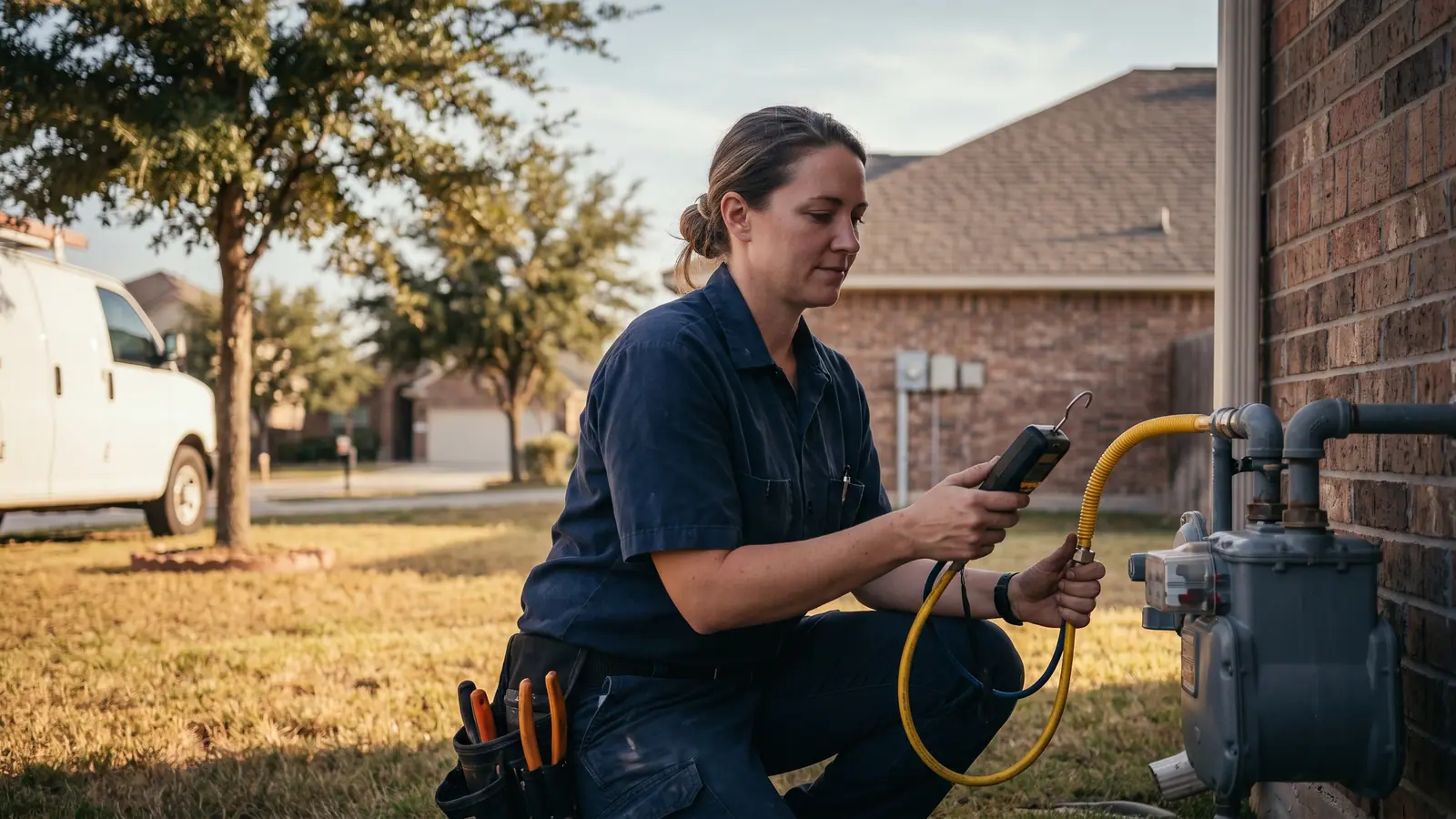
Gas Line Repair in San Antonio — Licensed, Tested, Safe
If you smell gas right now: leave the house, do not flip any switches, and call CPS Energy from outside — then call us. For everything short of an emergency, our licensed gas plumbers handle it start to finish.
Gas work is not a handyman job, and in Texas it is not legally allowed to be one — gas piping must be installed and repaired under a licensed plumber, and for good reason. Hill Country Plumbing Pros performs gas leak repair, line replacement, and pressure testing across Schertz, Cibolo, Universal City, Converse, and the greater NE San Antonio metro. Older neighborhoods here add their own risks: decades-old black iron pipe corrodes at threaded joints, and the ground movement that expansive Blackland clay soil inflicts on slab-on-grade homes stresses buried and under-slab gas runs the same way it stresses water lines. When CPS Energy red-tags a meter after finding a leak, we run the pressure test, isolate the failure, make the repair, and get you cleared for restoration.
The other half of our gas work is new capacity. Gas line installation for kitchen range conversions, dryers, outdoor kitchens, fire pits, pool heaters, and standby generators — a request that has surged since the Uri and January 2026 freezes left so many homes dark for days — all starts with a load calculation, because adding a generator or pool heater to an undersized line starves every appliance on it. We also inspect and correct CSST bonding: yellow flexible gas tubing that is not properly bonded to the electrical grounding system is a documented lightning fire risk, and we find unbonded runs in NE-metro attics constantly.
What’s Included
- Licensed gas leak repair with electronic leak detection and soap testing
- Full-system pressure testing for CPS Energy red-tag clearance
- Gas line installation for ranges, dryers, and water heaters
- New runs for outdoor kitchens, fire pits, pool heaters, and standby generators
- Load calculations and line re-sizing when appliances are added
- CSST bonding inspection and correction to current code
- Permits and city inspection coordination handled for you
How It Works
- Safety firstActive gas smell means evacuate and call CPS Energy from outside — they shut off and make safe for free. We take it from there.
- Pressure test and locateWe isolate the house piping, put it under test pressure, and use electronic detection to pinpoint exactly which joint or section is leaking.
- Repair or run new lineFailed sections are replaced — not patched — and new runs are sized from a proper load calculation, permitted, and installed to code.
- Test, inspect, restoreThe system holds test pressure for the required duration, the city inspector signs off where permits apply, and gas service is restored with every appliance relit.
What It Costs
Gas leak repair in the San Antonio metro typically runs $250 to $800 when the failure is accessible — a corroded fitting, a failed valve, a bad flex connector. Leaks in buried or under-slab lines cost more because of excavation, and in some cases rerouting a new line overhead beats digging up the old one. Pressure testing for a red-tag clearance generally runs $150 to $350.
New gas line installation is priced by run length, pipe size, and access: a short range or dryer run often lands between $400 and $900, while longer runs to a detached outdoor kitchen, pool heater, or standby generator commonly run $1,200 to $3,500 in 2026 pricing, including permit and inspection. Every quote is firm before work starts.
$250–$800 typical leak repair · $400–$3,500 new line installation
What moves the price
- Accessible fitting repair vs. buried or under-slab line work
- Run length, pipe diameter, and total appliance load
- Trenching and surface restoration for exterior runs
- Permit and city inspection requirements for the scope
Gas Line Services FAQs
I smell gas in my house. What do I do first?
Leave immediately — do not operate light switches, phones, or anything that can spark on your way out. From outside, call CPS Energy (they respond to gas emergencies around the clock at no charge), then call us. Once the utility makes the site safe, we find and repair the leak and get your service restored.
Why does gas work require a licensed plumber in Texas?
State law places fuel gas piping under the plumbing license because the failure mode is not a puddle — it is fire, explosion, or carbon monoxide. Licensed work also means permits and a city inspection, which protects you at insurance-claim time and home-sale time. Unpermitted gas work routinely kills real estate deals in Texas.
CPS Energy shut off my gas and red-tagged the meter. Now what?
That means a leak was detected somewhere in the house piping, and the utility will not restore service until a licensed plumber repairs it and the system passes a pressure test. We handle the full sequence — test, locate, repair, retest, and inspection — and coordinate the meter unlock so you are not stuck without hot water any longer than necessary.
Can you run gas for a standby generator or outdoor kitchen?
Yes — those are two of our most requested projects since the 2021 and 2026 freezes. The critical step is the load calculation: generators draw heavily, and tying one into an undersized line will starve your furnace and water heater when everything runs at once. We size the run correctly, pull the permit, and coordinate the inspection.
What is CSST bonding and do I need it?
CSST is the yellow corrugated flexible gas tubing common in homes built since the late 1990s. Code requires it to be bonded to the electrical grounding system because a nearby lightning strike can otherwise arc through the thin wall and start a fire. If your CSST has never been checked, a bonding inspection is quick and the correction is inexpensive.
Need gas line services today?
Call now — talk to a dispatcher, not a phone tree.