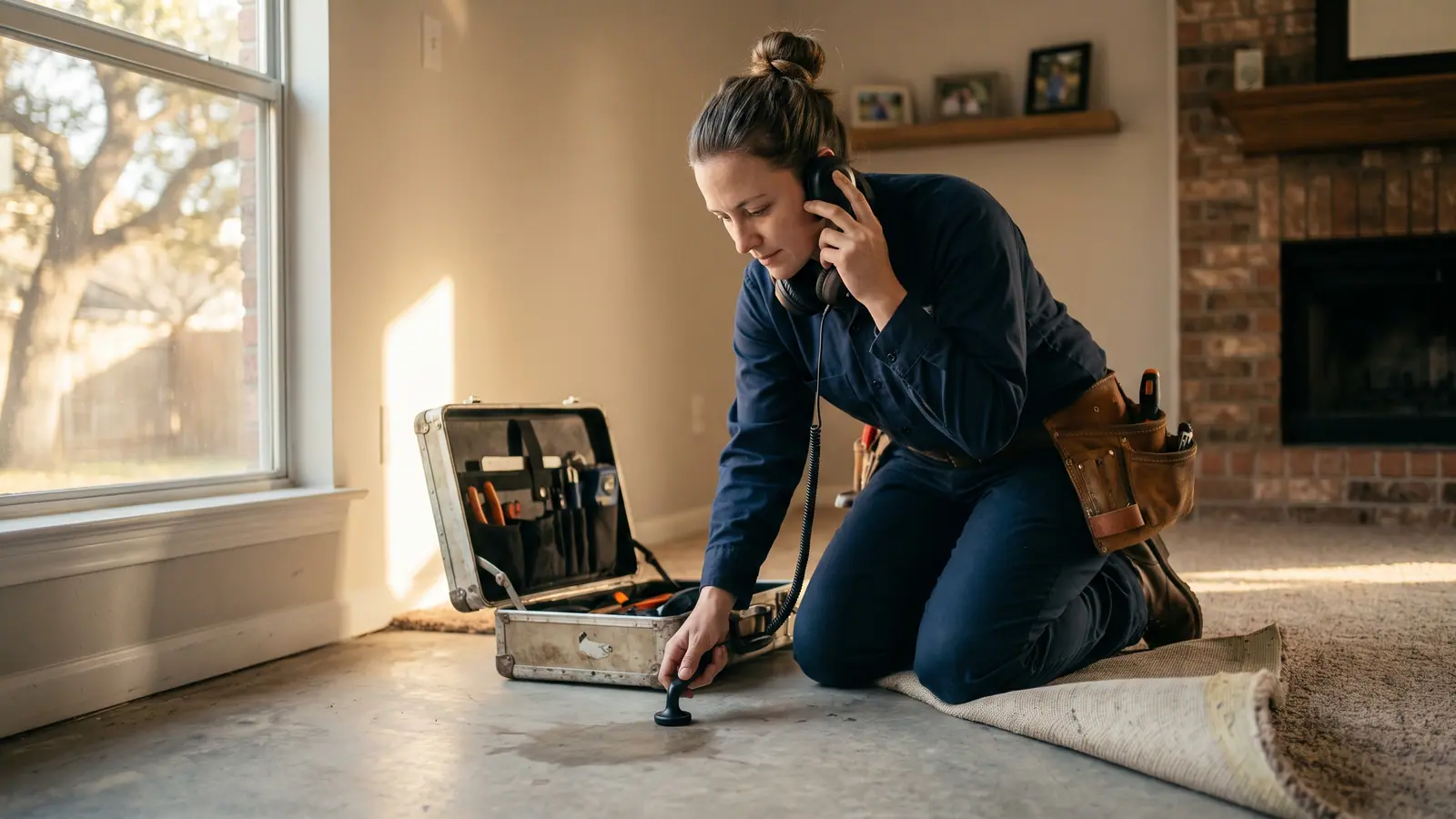
Slab Leak Repair in San Antonio — Detection Through Done
A warm spot on the floor, a bill that will not come down, the sound of water with everything off — classic slab leak. We pinpoint it, lay out every repair path with real prices, and handle the fix.
Slab leaks are practically a regional specialty. Nearly every home from Converse to Garden Ridge is built slab-on-grade, with copper supply lines cast into or routed beneath the concrete — and beneath that concrete sits expansive Blackland clay that swells in wet years and shrinks hard in drought. Each cycle flexes the foundation fractionally, and the copper flexes with it, wearing at bends and rub points until a pinhole opens. Add interior corrosion from 14–15+ grain hard water and it is no mystery why slab leak detection calls come in every week of the year, with a surge after soil-moisture swings like the ones that followed the January 2026 freeze.
The repair decision matters as much as finding the leak, because there are three honest answers and they carry very different price tags. A spot repair opens the slab at the marked point and fixes that failure. A reroute abandons the leaking run in place and feeds that fixture through new PEX overhead — no jackhammer, and the vulnerable line under the slab is retired for good. A repipe replaces the whole under-slab supply system, the right call when this is the second or third leak in an aging system. Hill Country Plumbing Pros prices all three against your home’s actual condition, and explains how each interacts with a foundation leak repair insurance claim before you commit.
What’s Included
- Exact leak location with acoustic and thermal equipment before any concrete is touched
- Spot repair: controlled slab access, copper repair, and concrete patch-back
- Reroute option: abandon the failed run and feed the fixture via overhead PEX
- Whole-home repipe pricing when a system has entered its leak-a-year phase
- Hot-side and cold-side leaks on copper, and older galvanized under-slab lines
- Documentation package for your homeowners insurance claim
- Pressure test and walkthrough of the completed repair before we leave
How It Works
- Pinpoint the leakIsolation testing, thermal imaging, and acoustic locating mark the failure to within a foot or two — so any slab opening is measured in inches, not rooms.
- Present all three pathsSpot repair, reroute, and repipe, each with a firm price, its disruption level, and our honest read on which one your home’s history supports.
- Make the repairSlab access is cut and contained cleanly, or the reroute runs through the attic with proper insulation — either way the failed line is verified dead and dry.
- Test and documentThe system is pressure-tested, the site restored, and you receive the photo and findings package your insurance adjuster will ask for.
What It Costs
In the 2026 San Antonio market, slab leak work runs roughly $630–$4,400: simple single-point repairs with easy access sit toward the bottom, typical spot repairs with concrete opening and patch-back land mid-range, and reroutes of longer runs — often the smarter fix — occupy the upper band. A whole-home repipe is quoted separately when the leak history justifies it.
On insurance: most Texas homeowners policies exclude the plumbing repair itself but cover access — the tearing out and restoring of slab and flooring needed to reach the leak — plus resulting water damage. That distinction decides whether filing makes sense, and adjusters respond to evidence. Our locate report, photos, and itemized invoice separate access costs from repair costs so the covered portion is clearly documented.
$630–$4,400 for most slab leak repairs and reroutes
What moves the price
- Repair path chosen: spot repair vs. reroute vs. full repipe
- Leak position — under a hallway edge vs. beneath a kitchen island or bathroom
- Flooring above the access point: tile and wood cost more to restore than carpet
- Hot vs. cold line, depth, and how the line was originally routed
📘 Related guide: Warning signs of a slab leak
Slab Leak Repair FAQs
What does a slab leak feel and sound like?
The signature symptom is a warm spot on the floor — a hot-side line leaking under the slab heats the concrete above it, and pets often find it first. Other tells: hissing or running-water sound with all fixtures off, a spinning meter, unexplained bill increases, damp baseboards, and hairline floor cracks that follow a line.
Why do slab leaks happen so much in San Antonio?
Geology and water chemistry gang up on the pipe. Slab-on-grade construction puts copper in or under concrete, expansive Blackland clay moves that slab a little with every wet-dry cycle, and the movement wears the copper at contact points. Meanwhile 14–15+ grain hard water and its treatment chemistry work on the pipe wall from inside. The pipe is attacked from both sides for decades.
Should I choose a spot repair or a reroute?
Spot repair makes sense for a first leak in an otherwise healthy system — it is cheaper and faster. But copper that has failed once under the slab is telling you about its condition, so for a second leak, a long defective run, or a leak under expensive flooring, the reroute usually wins: no jackhammer, and that vulnerable segment is retired permanently. We give you our recommendation and the reasoning, then you decide.
Will my homeowners insurance cover a slab leak?
Usually partially. Texas policies typically exclude fixing the pipe itself but cover access — breaking and restoring the slab and flooring to reach the leak — and the resulting water damage, subject to your deductible. Because access is often the largest cost on a slab job, that coverage matters. We document and itemize the job so the covered and uncovered portions are unambiguous.
How disruptive is the repair? Do I have to move out?
Almost never. A spot repair means one contained opening of a few square feet, with dust barriers up and most jobs finished in a day plus concrete cure time. A reroute involves no slab opening at all — work happens in the attic and at wall penetrations, and water is typically back on the same evening. Full repipes take two to three days with water restored each night.
Need slab leak repair today?
Call now — talk to a dispatcher, not a phone tree.