Water Softener Installation in San Antonio — Beat the Hardest Water in Texas
San Antonio has some of the hardest municipal water in the country. A properly sized softener is the single best investment in every appliance and fixture that touches water in your home.
The northeast San Antonio metro sits on Edwards Aquifer limestone, and the water proves it: most of our service area tests at 14–15+ grains per gallon, and some Cibolo streets swing anywhere from 10 to 22 gpg depending on which wells are feeding the system that week. That is among the hardest municipal water in the United States. Every gallon leaves calcium behind — white crust on faucets, cloudy glassware, stiff laundry, dry skin, and, invisibly, a thickening layer of scale inside your water heater and pipes. Hill Country Plumbing Pros installs whole-home water softener systems across Schertz, Cibolo, New Braunfels, Garden Ridge, Seguin, and the surrounding suburbs.
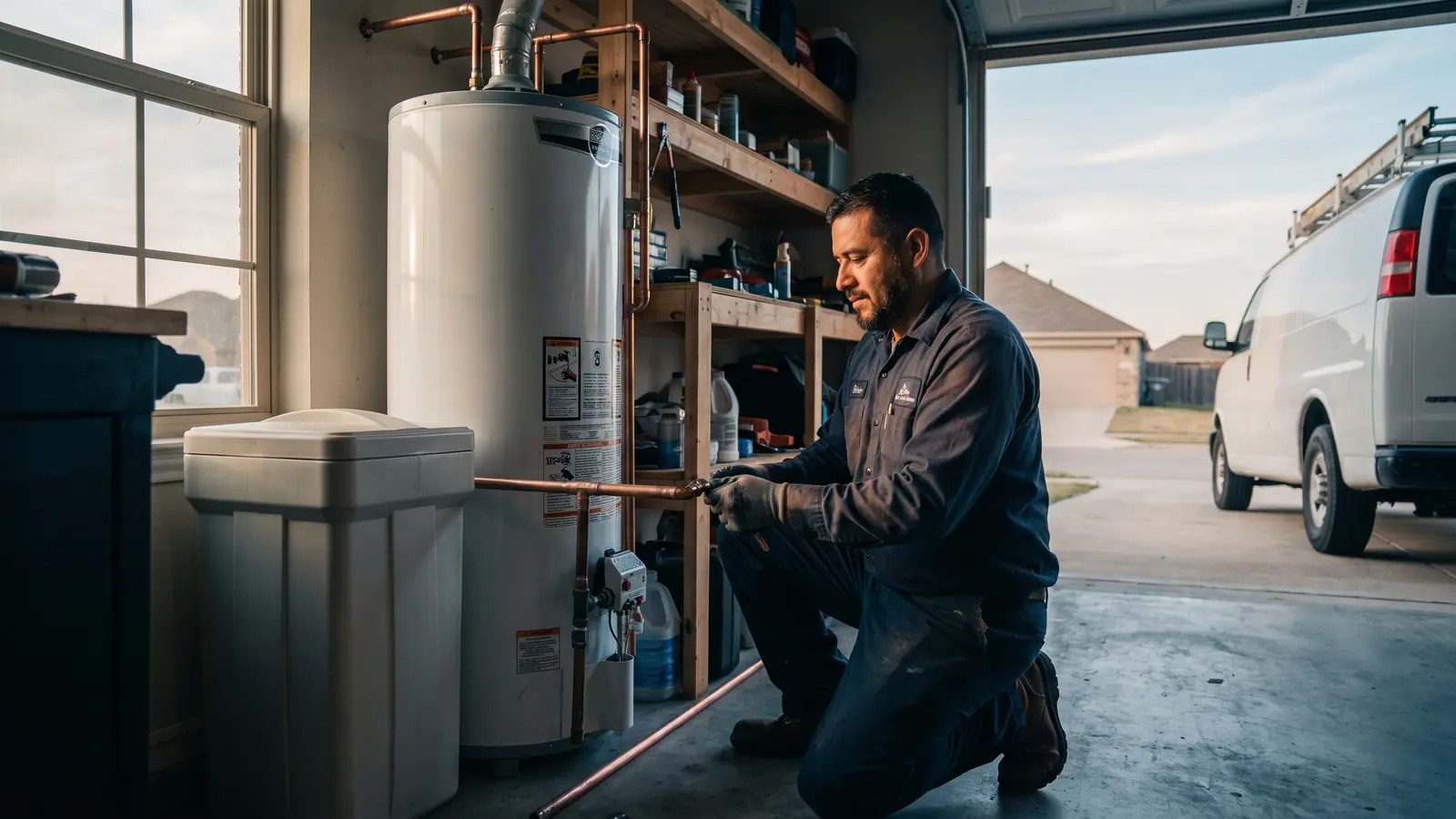
The financial case is simpler than most people expect. Hard water treatment is really appliance protection: a softener typically adds two to four years of life to a tank water heater, keeps tankless units from scaling into early error codes, and stops the cartridge and fill-valve failures that drive so many of our repair calls. Sizing is the part that matters — grain capacity matched to your household size and actual hardness, not whatever box a big-box store had on the shelf. Many newer homes here have a pre-plumbed softener loop in the garage, which makes installation clean and quick; older homes without one, we cut in properly.
What’s Included
- Free water hardness test at your tap before we recommend anything
- Grain-capacity sizing matched to household size and measured hardness
- Quality metered softener systems — no proprietary lock-in on salt or parts
- Installation on existing softener loops or new loop cut-ins for older homes
- Bypass valve and drain line plumbed to code
- Startup programming, salt fill, and a walkthrough of maintenance
- Optional carbon filtration add-on for chlorine taste and odor
How It Works
- Test the waterWe measure hardness at your tap — not from a city average — because readings across the NE metro vary block to block.
- Size the systemHousehold headcount, measured gpg, and water usage set the grain capacity. Oversizing wastes money; undersizing wastes salt and soft water.
- Install and connectOn loop-ready homes the install takes a few hours. Without a loop, we cut in at the main, add the bypass, and route the drain properly.
- Program and proveWe set regeneration for efficiency, fill the brine tank, then retest your water to show the hardness at or near zero before we go.
What It Costs
Professionally installed water softener systems in the San Antonio metro run $1,500 to $3,500 in 2026 — the spread mostly reflects grain capacity, valve quality, and whether your home already has a softener loop. A loop-ready install of a quality 40,000-grain metered system for a family of four sits near the middle of that range.
Be careful comparing that number to a $600 big-box unit: those quotes exclude installation, often use time-clock valves that regenerate whether needed or not, and are commonly undersized for our 15+ gpg water. A correctly sized metered system uses less salt, makes softer water, and lasts 12–15 years or more — the water softener cost difference pays itself back in appliance life alone.
$1,500–$3,500 installed · free in-home water test and quote
What moves the price
- Grain capacity — 32,000 to 64,000+ based on household and hardness
- Existing softener loop vs. new loop cut-in at the main
- Valve quality: metered on-demand vs. basic time-clock regeneration
- Add-ons like carbon filtration or a pre-filter for sediment
📘 Related guide: How hard water shortens water heater life
Water Softener Installation FAQs
How hard is the water in the San Antonio area, really?
Officially "very hard" — the top classification — at 14–15+ grains per gallon across most of the NE metro, with some Cibolo neighborhoods swinging between 10 and 22 gpg as supply wells rotate. For comparison, anything over 10.5 gpg earns the very hard label. Few US cities are worse.
Will a softener really make my water heater last longer?
Yes, and it is one of the best-documented benefits. Scale is what kills water heaters here — it blankets elements and burners and eats anode rods early. Softened water typically adds two to four years to a tank heater and is close to mandatory for tankless units, whose manufacturers can deny warranty claims for heavy scale.
My garage has capped pipes labeled for a softener. What are those?
That is a softener loop — builders in Schertz, Cibolo, and most newer NE-metro subdivisions pre-plumb one because they know what the water is like. It means your install is simple: we tie the softener into the loop, add a drain, and you are running the same day.
Is softened water safe to drink, and what about sodium?
It is safe for most people. Softening exchanges hardness minerals for a small amount of sodium — at our hardness levels, roughly 28 mg per 8-ounce glass, less than a slice of bread. Households on strict sodium limits often add a reverse-osmosis tap at the kitchen sink, which we can install with the softener.
How much maintenance does a softener actually need?
Very little: keep the brine tank at least a third full of salt — most families add a couple of bags every month or two — and let the metered valve handle the rest. We recommend a quick checkup every few years to clean the injector and confirm the settings still match your usage.
Need water softener installation today?
Call now — talk to a dispatcher, not a phone tree.