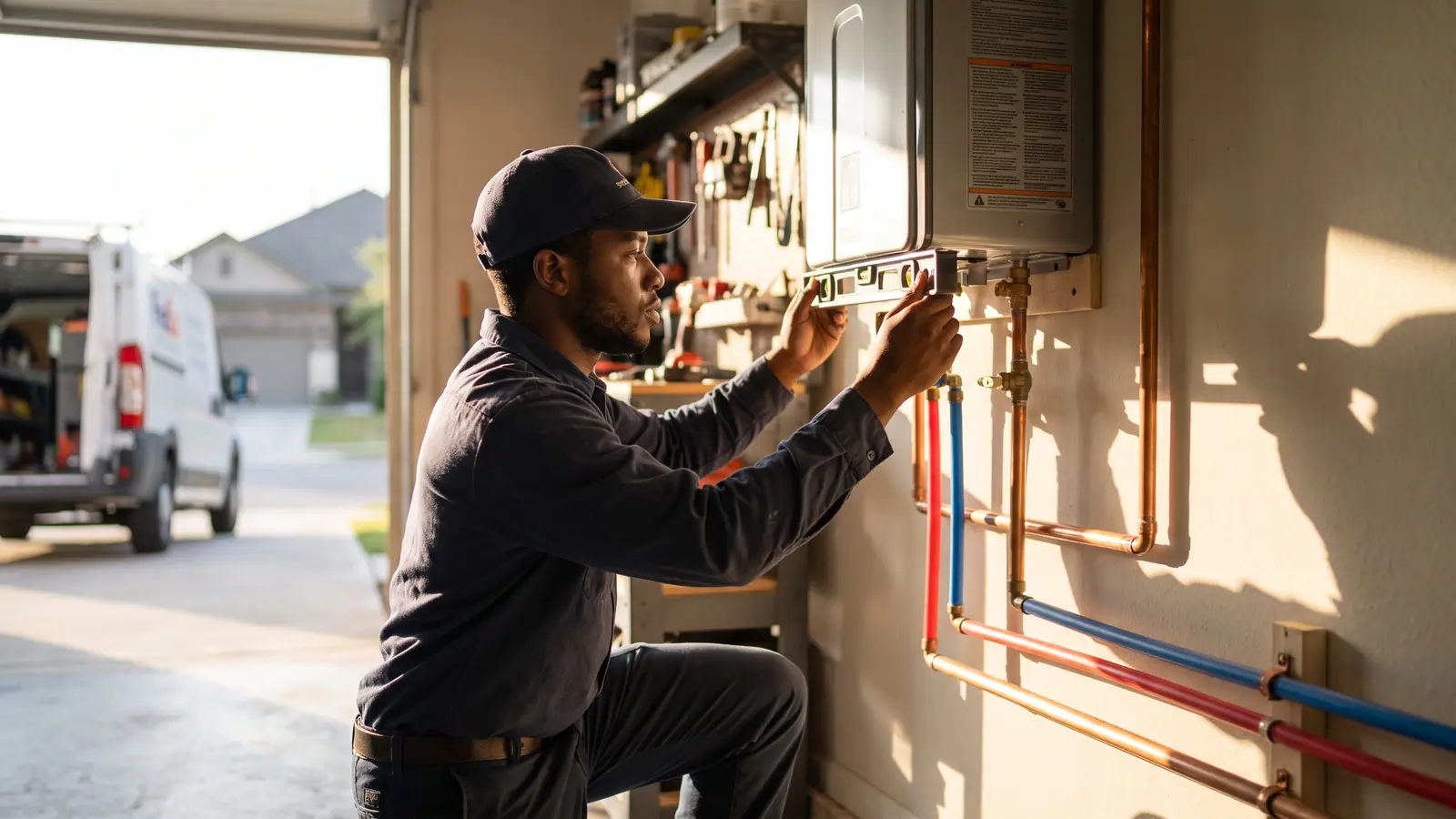
Tankless Water Heater Installation in San Antonio
Endless hot water, a 20-year lifespan, and a closet back — if the install is done right. We are the crew other plumbers call when a tankless conversion needs gas work and venting done properly.
Going tankless in San Antonio is a bigger job than swapping tanks, and that is where cut-rate installs go wrong. A gas tankless unit typically demands 150,000–199,000 BTU — several times what a standard tank draws — so the existing gas line usually needs upsizing, and condensing units need dedicated PVC venting run to the exterior. Hill Country Plumbing Pros handles the whole conversion: gas sizing calculations, venting, condensate drainage, isolation valves, and the permit, whether we are fitting a Rinnai, Navien, or Rheem unit in Schertz, Cibolo, New Braunfels, or anywhere in the NE metro.
One local truth the brochures skip: our 14–15+ grain-per-gallon hard water is the single biggest threat to a tankless heat exchanger. Scale chokes the narrow waterways and can cut the life of a neglected unit in half. Every installation we do includes isolation valves for easy annual descaling, and we will give you straight numbers on pairing the unit with a water softener — the combination that actually delivers the 20-year lifespan tankless owners are promised.
What’s Included
- Load calculation and unit sizing for your fixtures and household
- Rinnai, Navien, and Rheem certified installation — condensing and non-condensing
- Gas line upsizing and pressure verification for 150k–199k BTU demand
- Dedicated venting and condensate drain routed to code
- Isolation valve kit installed for fast annual descaling
- City permit, inspection, and manufacturer warranty registration
- Old tank removal and haul-away on conversions
How It Works
- In-home assessmentWe measure your gas meter capacity, line sizing, venting path, and hot water demand — the four things that decide whether a conversion is straightforward or needs prep work.
- Firm written proposalYou get an exact installed price with the unit model, gas work, and venting itemized, plus a tank-replacement price for comparison so you can judge the payback honestly.
- Installation dayMost conversions take one working day: remove the old tank, run the upsized gas line and venting, mount and plumb the unit, and commission it to the manufacturer spec.
- Commissioning and setupWe verify gas pressure under full fire, set your output temperature, register the warranty, and walk you through the descaling schedule that protects it.
What It Costs
A professionally installed gas tankless system in the 2026 San Antonio market runs $3,500–$6,500 all-in. The spread is mostly infrastructure: a home with a short venting run and adequate gas piping lands near the bottom, while a conversion needing 30 feet of upsized gas line, exterior wall venting, and an electrical outlet at the mounting location reaches the top.
Against a $1,400–$3,300 tank replacement, tankless costs more up front but roughly doubles the service life and trims gas usage 20–30% for most households. Whether the math favors you depends on how long you will stay in the home — our comparison guide below walks through the honest break-even.
$3,500–$6,500 installed for most gas tankless conversions
What moves the price
- Unit capacity and type — condensing vs. non-condensing, 160k vs. 199k BTU
- Gas line footage that needs upsizing between meter and unit
- Venting complexity: exterior wall proximity and routing path
- First-time conversion vs. replacing an existing tankless unit
📘 Related guide: Tankless vs tank: which is worth it?
Tankless Water Heater Installation FAQs
Will my existing gas line support a tankless water heater?
Usually not without changes. A tank heater draws around 40,000 BTU while a whole-home tankless unit demands up to 199,000, so the branch line — and sometimes the meter — needs upsizing. We measure this during the assessment and include any gas work in the quoted price rather than surprising you mid-install.
How does San Antonio hard water affect tankless units?
Severely, if ignored. At 14–15+ grains per gallon, scale builds inside the heat exchanger and restricts flow until the unit throws error codes or fails outright. Annual descaling through isolation valves — which we install standard — keeps it healthy, and a softener upstream nearly eliminates the problem.
Rinnai or Navien — which do you recommend?
Both are excellent, and we install both daily. Navien condensing units tend to win on efficiency and built-in recirculation options; Rinnai has a long reliability record and strong parts availability locally. We match the brand to your venting layout, budget, and whether you want recirculation, then let you pick.
How long does a tankless installation take?
A straightforward tank-to-tankless conversion is one working day, roughly six to eight hours. Jobs needing long gas line runs, a meter upgrade from CPS Energy, or relocating the unit to an exterior wall can stretch to two days. You will know the timeline before we start.
Is there really unlimited hot water with tankless?
Unlimited in duration, yes — the unit heats water as it flows, so a shower can run for hours. The limit is simultaneous flow: a properly sized 199k BTU unit handles two showers and a sink at once in our climate. If your household routinely runs more than that, we will size up or spec a second unit rather than let you be disappointed.
Need tankless water heater installation today?
Call now — talk to a dispatcher, not a phone tree.