10 Signs of a Slab Leak Every Texas Homeowner Should Know
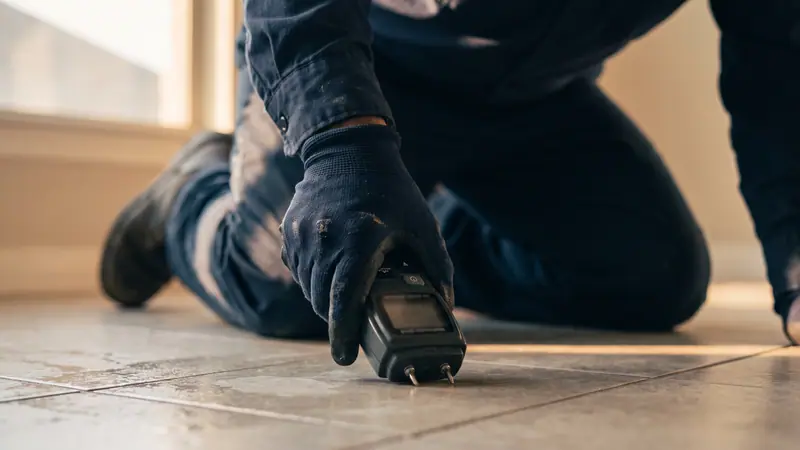
A slab leak is a broken water line running under or through the concrete foundation your house sits on — and because the evidence is buried under several inches of concrete, it can run for weeks before anyone notices. That delay is the expensive part. Water under a foundation erodes soil, feeds mold, and can shift the slab itself. Knowing the signs of a slab leak means catching the problem while it’s a plumbing repair instead of a foundation repair. Leaks are not a small problem in aggregate, either: the EPA estimates household leaks waste nearly 1 trillion gallons of water a year nationwide, with the average household’s leaks accounting for more than 9,300 gallons annually. Here’s what to watch for, a free ten-minute test you can run today, and what the fix actually costs — with sources for every number.
What are the most common signs of a slab leak?
The most common signs of a slab leak are warm spots on the floor, an unexplained jump in your water bill, the sound of running water when every fixture is off, a drop in water pressure, and new cracks in flooring or drywall. One of these alone deserves attention; two or more together is a strong signal that a pressurized line under the foundation is leaking.
Here are the ten slab leak symptoms we see most often on service calls, and what each one usually means:
| # | Warning sign | What it usually means | Urgency |
|---|---|---|---|
| 1 | Warm or hot spots on the floor | Hot-water line leaking under the slab, heating the concrete above it | High — hot-side leaks run 24/7 |
| 2 | Water bill jumps with no habit change | Pressurized line losing water around the clock | High |
| 3 | Sound of running water, everything off | Water actively moving through a break | High |
| 4 | Low water pressure house-wide | Leak bleeding pressure off the supply line | Medium-high |
| 5 | Cracks in tile, floors, or drywall | Soil under the slab eroding or swelling; slab flexing | High — foundation involvement |
| 6 | Damp carpet, cupping wood floors | Moisture wicking up through the slab | High |
| 7 | Musty odor or visible mold | Persistent moisture under flooring | Medium-high |
| 8 | Water heater running constantly | Hot-side leak draining the tank continuously | Medium |
| 9 | Doors and windows suddenly sticking | Foundation movement — swollen clay under one section | Medium — investigate the cause |
| 10 | Pooling water at the slab’s edge | Under-slab water surfacing along the path of least resistance | High |
A few of these deserve a closer look.
Warm floors are the classic giveaway. In our field experience, most of the slab leaks we open up are on the hot-water side, and that squares with the research: studies compiled by the Long Island Water Conference have shown pinhole leaks are more prominent in hot-water piping. Escaping hot water heats the concrete above it, so if your bare feet find a mysteriously warm patch of tile — and the dog keeps napping on it — that’s not a coincidence.
A rising bill is the leak talking to you. A pinhole in a pressurized line loses water 24 hours a day. The EPA notes that even ordinary household leaks add up to thousands of gallons per year; a pressurized under-slab break can waste far more, and every gallon shows up on your SAWS bill.
Cracks and sticking doors mean the soil is moving. Water undermines or swells the soil supporting the slab, the slab flexes, and cracks telegraph up through tile, grout lines, and sheetrock — often above doorways and windows. This is the point where a plumbing problem starts becoming a foundation problem, which is why these two signs push a slab leak from “schedule it” to “call today.”
How can you check for a slab leak yourself?
You can confirm whether something is leaking — for free, in about ten minutes — with your water meter. The EPA’s own leak-check method is simple: check the meter before and after a two-hour period when no water is being used, and if the reading changes at all, you probably have a leak.
Here’s the faster version we walk callers through:
- Shut off every fixture and water-using appliance: faucets, ice maker, irrigation, washing machine — and make sure no toilet is running.
- Find your water meter (usually in a box near the street) and look at the low-flow indicator — a small triangle, star, or dial.
- Watch it for several minutes. If it’s moving with everything off, water is leaving your system.
- Now close the house’s main shutoff valve and check again. If the meter stops, the leak is in or under the house. If it keeps spinning, the leak is in the yard line between the meter and the house.
This test tells you that you have a leak, not where. Pinpointing an under-slab leak is a job for professional leak detection equipment — and accuracy matters enormously, because the difference between opening the slab in the right spot and the wrong spot is measured in thousands of dollars.
Why are slab leaks so common in San Antonio?
Slab leaks are common across the northeast San Antonio metro because four risk factors stack on top of each other: slab-on-grade construction, expansive Blackland clay soil, very hard water, and periodic hard freezes. Most of the country deals with one or two of these; we deal with all four.
Slab-on-grade construction. Almost every home in Schertz, Cibolo, Universal City, New Braunfels, and Garden Ridge is built on a concrete slab with water lines running beneath or within it. There’s no basement or crawlspace where a leak would be visible and easy to reach.
Expansive Blackland clay. Much of the corridor sits on Houston Black clay, the official Texas state soil and a textbook expansive Vertisol. The USDA’s official soil series description puts its clay content at 40 to 60 percent, with high shrink-swell potential and surface cracks up to 4 inches wide during dry periods. Every wet-dry cycle moves the ground, the ground moves the slab, and the slab works the pipes cast into it. Copper lines rubbing against concrete or rebar during that movement wear through at exactly the spots no one can see.
Very hard water. SAWS reports typical hardness of 15 to 20 grains per gallon — firmly in the “very hard” range. Water chemistry is one of the recognized drivers of pinhole pitting corrosion in copper: the Long Island Water Conference notes that water pH and alkalinity, aging hot-water systems, and thin-walled pipe all contribute, and that while copper’s design life is 50 to 70 years, failures can occur much earlier. Homes here from the 1970s–1990s with original soft copper under the slab are especially vulnerable.
Freeze events. Winter Storm Uri in February 2021 generated more than 456,000 insurance claims in Texas with an expected payout of $8.2 billion — much of it from freezing pipes. In our experience, lines stressed by a hard freeze don’t always fail during the freeze; weakened joints and wear points can let go months later, which is why slab-leak calls climb in the seasons after every arctic outbreak, including the January 2026 event.
How do plumbers find a slab leak?
Plumbers locate slab leaks without breaking concrete by isolating the leaking line with pressure testing, then pinpointing the break with acoustic listening equipment, electronic line tracing, and thermal imaging. Done right, the slab gets opened once, in the right place — or not at all if a reroute makes more sense.
The process usually runs in this order: pressure-isolate the hot and cold sides to identify which line is losing water, trace the line’s actual path under the slab (it’s rarely where the builder’s drawings say), then use amplified listening discs and thermal cameras to mark the break within inches. HomeAdvisor puts professional leak detection at $150 to $400 — cheap insurance against jackhammering the wrong room. That pinpoint accuracy is the core of our leak detection service, and it’s the step that controls the cost of everything that follows.
How much does slab leak repair cost in 2026?
Slab leak repair costs most homeowners between roughly $630 and $4,400, with a national average around $2,280, according to HomeAdvisor’s 2026 cost data. Where you land in that range depends mostly on access — a leak under a utility area is far cheaper to reach than one under a finished kitchen floor.
There are three ways to fix a slab leak, and the right one depends on the pipe’s overall condition, not just the leak in front of you:
| Repair option | Typical cost | Disruption | Best for |
|---|---|---|---|
| Spot repair (open the slab, fix the pipe) | $630–$4,400, avg. ~$2,280 (HomeAdvisor) | High — jackhammering, dust, re-pour, flooring repair | Newer homes with an isolated, accessible failure |
| Reroute (abandon the buried line, run new PEX overhead) | $600–$4,000 (HomeAdvisor); long runs cost more | Low — attic and wall access, small drywall patches | Most single-line slab leaks; the go-to fix in our area |
| Whole-house repipe | Roughly $4.50/sq ft installed (HomeAdvisor) | Moderate — 2–4 days, multiple drywall openings | Homes with repeat leaks or end-of-life copper/galvanized |
Budget beyond the plumbing, too: if water ran long enough to damage flooring or the foundation itself, HomeAdvisor notes water damage restoration can add $500 to $15,000+ and foundation stabilization runs $2,500+ per pier. That’s the math behind acting on slab leak symptoms early — the plumbing repair is rarely the expensive part of a leak that ran for months. Our slab leak repair service covers all three repair paths.
Should you repair the spot, reroute the line, or repipe the house?
Repair the spot only when the home is newer and the failure is clearly isolated; reroute when a single aging line has failed; repipe when the home has had two or more slab leaks or the original copper is at end of life. Fixing one pinhole in a line that’s corroding from the inside is often just a down payment on the next leak.
Our rule of thumb from the field: the second slab leak is the pipe telling you it’s done. At that point every dollar spent on spot repairs is a dollar not spent on the permanent fix.
How much does it cost to repipe a house?
Repiping a house costs roughly $4.50 per square foot installed on average, per HomeAdvisor’s 2026 data — about $6,750 for a 1,500-square-foot home and $11,250 for 2,500 square feet. Material choice moves the number: PEX tubing runs $0.40–$4 per linear foot versus $2–$12 for copper, and copper’s soldered fittings take far more labor.
| Home size | Typical installed cost (2026) |
|---|---|
| 1,500 sq ft | ~$6,750 |
| 2,500 sq ft | ~$11,250 |
| 3,000 sq ft | ~$13,500 |
Figures from HomeAdvisor’s national repipe data at roughly $4.50/sq ft; local quotes vary with fixture count, access, and finish-out.
PEX dominates repipes in Texas for practical reasons: it tolerates freezes better than rigid pipe, it’s immune to the pitting corrosion that kills copper in hard water, and it installs faster because it bends around corners instead of requiring soldered fittings at every turn. Most of our repipes take two to four days, and drywall patching should be spelled out in the quote — confirm that before you sign. See our repiping service for what the process involves.
Does homeowners insurance cover slab leaks in Texas?
Texas homeowners policies generally cover sudden and accidental water damage — but not gradual leaks, and usually not the pipe repair itself. The Texas Department of Insurance is explicit: most policies cover sudden and accidental water damage like a burst pipe, but “usually won’t cover damage from gradual leaks or seepage.”
In practice, that means a slab leak claim often pays for the resulting damage and the cost of accessing the leak — tearing out and re-pouring concrete, replacing ruined flooring, drying the structure — while the plumbing fix comes out of pocket as wear and tear. These claims are common and expensive: Insurance Information Institute data shows about 1 in 60 insured homes files a water damage or freezing claim each year, with an average payout of $13,954 (2018–2022).
Two Texas-specific points worth knowing:
- Foundation and slab endorsements exist. TDI’s home insurance guide lists “damage to foundations or slabs” among the add-on coverages Texas insurers offer. In Blackland clay country, that endorsement is worth asking your agent about before you need it.
- Don’t sit on symptoms. Because gradual leaks are excluded, a leak you demonstrably ignored for months is a claim an adjuster can deny. Document everything — photos, the leak detection report, invoices — and act when the signs first appear.
Need help in the San Antonio area?
If you’re seeing one or more signs of a slab leak — a warm floor, a spinning meter, a bill that doesn’t make sense — don’t wait for the flooring to buckle. Hill Country Plumbing Pros provides electronic leak detection and every repair path, from pinpoint spot repairs to full reroutes and repipes, across Schertz, Cibolo, Universal City, New Braunfels, and the northeast San Antonio metro. Call (210) 555-0199 or visit our Slab Leak Repair in San Antonio page to get answers today.
References
- U.S. EPA WaterSense — Fix a Leak Week
- Insurance Information Institute — Facts + Statistics: Homeowners and renters insurance
- Texas Department of Insurance — When are water damage and mold covered by insurance?
- Texas Department of Insurance — Home insurance guide
- HomeAdvisor — How Much Does Slab Leak Repair Cost? (2026)
- HomeAdvisor — How Much Does It Cost to Repipe a House? (2026)
- San Antonio Water System — Water Quality FAQs
- USDA Natural Resources Conservation Service — Houston Black Official Soil Series Description
- Insurance Journal — More than 456.5K Claims Filed in Texas After Winter Storm
- Long Island Water Conference — Pinhole Leaks