Water Heater Replacement Cost in 2026: What You'll Actually Pay
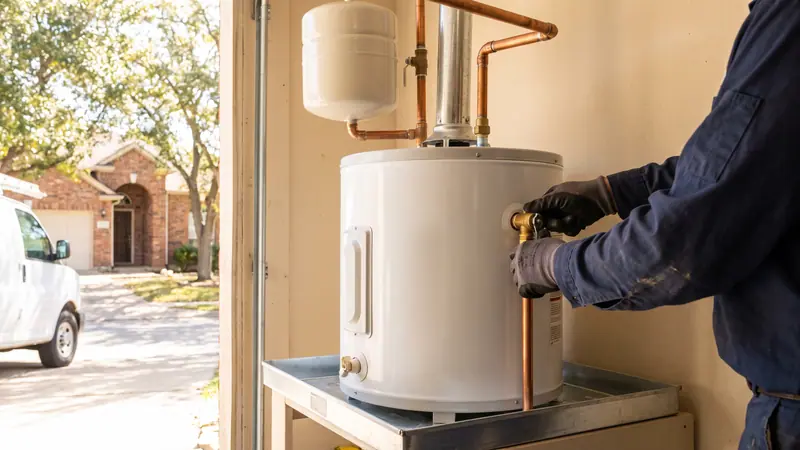
If your water heater is on its way out, the first question is almost always the same: what is this going to cost me? In 2026, water heater replacement cost runs from about $1,200 on the low end to $3,500 or more for a standard tank unit installed, and $3,500 to $7,500+ if you’re switching to tankless. That’s a wide range, and where you land depends on tank size, fuel type, where the unit sits in your home, and local code requirements — including a few that are specific to the San Antonio metro.
This guide breaks down real 2026 prices, the factors that push your quote up or down, and how to tell whether you should be paying for a replacement at all — or just a repair.
Water Heater Replacement Cost by Size and Type
The single biggest driver of price is what you’re installing. Here’s what homeowners are paying in 2026, both nationally and in the San Antonio metro. “Installed cost” includes the unit, labor, standard code upgrades (expansion tank, pan, venting adjustments), haul-away of the old unit, and the permit.
| Water Heater Type | Unit Cost (2026) | Installed Cost (2026) |
|---|---|---|
| 40-gallon tank (gas or electric) | $500 – $1,100 | $1,200 – $2,200 |
| 50-gallon tank (gas or electric) | $600 – $1,400 | $1,400 – $2,600 |
| 75-gallon tank (gas) | $1,200 – $2,400 | $2,400 – $3,900 |
| Tankless (whole-home, gas) | $1,200 – $2,800 | $3,500 – $7,500+ |
A few notes on reading this table:
- The 50-gallon tank is the workhorse. For a family of three to five, 50 gallon water heater cost lands between $1,400 and $2,600 installed in most San Antonio-area homes — assuming a straightforward swap in the same location with the same fuel type.
- Gas usually costs slightly more than electric to install because of venting and gas line work, but it’s cheaper to operate month to month at Texas energy prices.
- Tankless has a big installed-cost premium because it often requires upsizing the gas line, new venting, and sometimes an electrical circuit. It pays that back over a 20+ year lifespan — but only if it’s maintained (more on hard water below).
7 Factors That Move Your Quote Up or Down
Two neighbors in Schertz can get quotes $1,000 apart for the “same” 50-gallon replacement. Here’s why.
1. Location of the unit
Garage installs — the most common setup in NE San Antonio suburbs — are the cheapest. Attic installs add $300–$700 because of access difficulty, required drain pans and drain lines, and the extra labor of hauling a unit up and down. Closet installs inside conditioned space fall in between.
2. Code upgrades
If your old heater was installed 10–15 years ago, code has changed since. Expect line items for a thermal expansion tank ($100–$250 installed), updated T&P discharge piping, seismic/stability strapping where required, a drain pan with a routed drain line, and sometimes a raised stand for garage gas units. These aren’t upsells — inspectors check for them.
3. Fuel type changes
Swapping gas-for-gas or electric-for-electric is simple. Converting from electric to gas (or vice versa) adds $500–$1,500+ for gas line or electrical work.
4. Venting
Older atmospheric-vent gas heaters are being replaced by units with stricter venting requirements. If your flue needs modification, budget an extra $200–$600.
5. Water quality
Here’s the Texas-specific one: water in the NE San Antonio metro — Schertz, Cibolo, Universal City, New Braunfels — commonly tests at 15+ grains per gallon of hardness. That’s “very hard” on any scale. Scale buildup is the number one reason tanks in this area fail at year 8 instead of year 12. If you’re replacing a heater that died young, it’s worth pricing water softener installation at the same time. A softener typically adds $1,500–$3,000 but can extend your new heater’s life by several years and preserve the manufacturer’s warranty terms on some models.
6. Brand and warranty tier
A 6-year-warranty builder-grade tank and a 12-year premium tank can differ by $300–$500 in unit cost. In hard-water territory, the longer-warranty models — which usually have thicker anode rods and better tank linings — are generally worth it.
7. Emergency timing
A leaking tank on a Saturday night costs more to replace than a planned swap on a Tuesday. If your heater is 10+ years old, replacing it on your schedule instead of the tank’s schedule is the easiest money you’ll save.
Yes, You Need a Permit (and Why That’s Good)
San Antonio metro cities require permits for water heater replacement — that includes San Antonio proper, Schertz, Cibolo, Universal City, and New Braunfels. Permit fees typically run $50–$150 and should be included in a reputable plumber’s quote.
Some homeowners see the permit as a tax and are tempted to skip it. Don’t. The inspection verifies your T&P relief valve discharge, gas connections, and venting — the things that prevent scalding, carbon monoxide problems, and (rarely but catastrophically) tank explosions. An unpermitted water heater can also create headaches when you sell the house or file an insurance claim for water damage. If a contractor offers to skip the permit to save you money, that tells you something about the rest of their work.
When Repair Beats Replacement
Not every misbehaving water heater is dead. As a rule of thumb:
Repair it if:
- The unit is under 8 years old and the tank itself isn’t leaking
- The problem is a failed heating element, thermostat, thermocouple, gas valve, or T&P valve — these repairs typically run $150–$600
- The repair cost is less than about a third of the cost to replace water heater equipment of the same size
Replace it if:
- The tank body is leaking (a corroded tank cannot be repaired — period)
- The unit is 10+ years old and needs any repair over ~$500
- You’re seeing rusty hot water, which usually means the tank is corroding from the inside
- Repairs are becoming a pattern — two service calls in two years on an old unit means the third is coming
If you’re not sure which side of the line you’re on, a diagnostic visit is cheap compared to guessing wrong in either direction. Our water heater repair team will tell you straight if a $300 fix will buy you five more years — or if you’d be putting a new part on a tank that’s about to let go.
Hard Water Is Quietly Shortening Your Heater’s Life
One more time, because it changes the math on everything above: NE San Antonio metro water is hard enough that unmaintained tank heaters here routinely lose 2–4 years of expected lifespan. Scale settles at the bottom of gas tanks and insulates the burner from the water (that popping/rumbling sound is water boiling under a scale layer), and it eats sacrificial anode rods years ahead of schedule.
Two ways to protect a new heater:
- Flush the tank annually and check the anode rod every 2–3 years. Cheap insurance — a flush is a DIY job or a modest service call.
- Install a water softener. It protects the heater plus every fixture, appliance, and pipe in the house. If you’ve replaced a heater early once already, a softener usually pays for itself before the next replacement would have come due.
Need help in the San Antonio area?
If your water heater is aging out — or already leaking — Hill Country Plumbing Pros replaces tank and tankless units across Schertz, Cibolo, Universal City, New Braunfels, and the NE San Antonio metro, with upfront pricing and permits handled for you. Call (210) 555-0199 for a straight answer on repair vs. replace, or learn more about Water Heater Replacement in San Antonio.