Tankless vs Tank Water Heater: Which Is Right for Your Home?
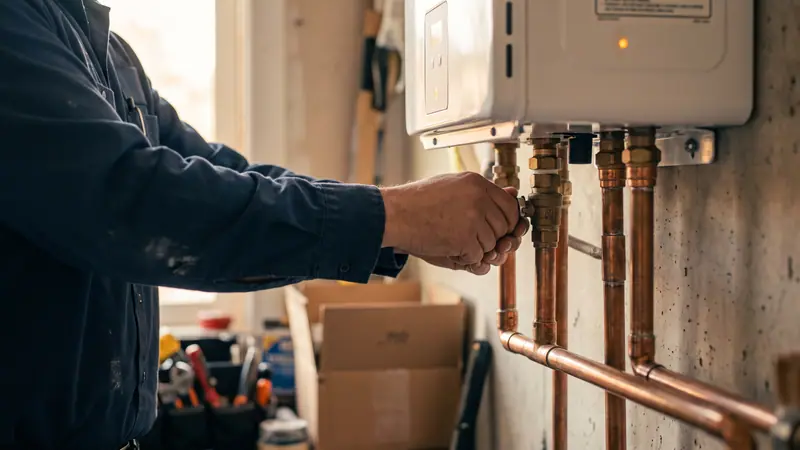
When your water heater comes due for replacement, you face a fork in the road: another tank like the one you’ve got, or the switch to tankless. The tankless vs tank water heater decision isn’t close to one-size-fits-all — tankless wins on lifespan, efficiency, and endless hot water, while tank wins on upfront cost and simplicity. And in the NE San Antonio metro, there’s a third factor most national comparison articles skip entirely: water hard enough to make or break a tankless investment.
Here’s the full comparison with 2026 numbers, honest pros and cons, and a straightforward framework for deciding which side of the fork you belong on.
How Each One Works (in 30 Seconds)
A tank water heater keeps 40–75 gallons hot around the clock, reheating as needed whether you’re using hot water or sleeping. Simple, proven, cheap to install — but it loses heat constantly (standby loss) and can run out during back-to-back showers.
A tankless water heater heats water only when a tap opens, firing a powerful gas burner (or electric element) as water flows through a heat exchanger. No storage, no standby loss, no running out — but a higher price of admission and more demanding installation.
Tankless vs Tank Water Heater: Decision Matrix
Here’s the head-to-head with realistic 2026 figures for the San Antonio metro:
| Factor | Tank (50-gal gas) | Tankless (whole-home gas) |
|---|---|---|
| Upfront installed cost | $1,400 – $2,600 | $3,500 – $7,500+ |
| Annual operating cost | $250 – $450 | $175 – $300 (24–34% less energy) |
| Lifespan | 8 – 12 years | 15 – 20+ years |
| Hot water supply | 40–50 gal, then wait for recovery | Endless at rated flow |
| Flow rate limit | Whole tank available at once | 5 – 10 GPM (unit-dependent) |
| Space required | ~9 sq ft floor footprint | Wall-mounted, roughly suitcase-sized |
| Hard-water maintenance | Annual flush + anode rod checks | Annual descaling required (warranty condition) |
| Leak/flood risk at failure | 40–75 gallons on your floor | Minimal — no stored water |
The lifespan line deserves emphasis: over 20 years you’d likely buy two tanks (and pay two installs) versus one tankless unit. That’s how tankless closes most of its upfront cost gap — slowly, and only if it lives long enough. Which brings us to hard water.
The San Antonio Hard-Water Catch
Water across the NE metro — Schertz, Cibolo, Universal City, New Braunfels — runs 15+ grains per gallon of hardness, courtesy of the limestone Edwards Aquifer. Inside a tankless heat exchanger, those minerals bake onto narrow waterways every time the burner fires. Unmanaged, scale will throttle flow, trigger error codes, tank your efficiency, and kill a “20-year” unit in 8–12 years. Nearly every manufacturer requires documented periodic descaling in hard-water areas to honor the warranty.
So in this metro, tankless ownership realistically means one of two commitments:
- Annual descaling — a vinegar/descaler flush through service valves, roughly $150–$250 as a service call or DIY-able with a pump kit, or
- A water softener — which protects the tankless unit (and every appliance in the house) and can stretch descaling to every 2–3 years. See our water softener installation service — pairing a softener with tankless is the configuration we most often recommend here.
Neither is a dealbreaker. But if you know you won’t keep up with maintenance, a tank — which is more tolerant of neglect — may honestly serve you better.
Tankless Water Heater Pros and Cons
Weighing tankless water heater pros and cons honestly, for this area specifically:
Pros
- Endless hot water — no recovery wait after three showers and a laundry cycle
- 20+ year potential lifespan (with maintenance) vs 8–12 for a tank
- 24–34% lower energy use for typical households; no standby losses
- Frees up ~9 square feet of garage or closet space
- No 50-gallon flood when it fails — a meaningful point in slab-foundation homes where a tank failure sends water straight into drywall, not a basement
- Federal tax credits often available for qualifying high-efficiency condensing models in 2026
Cons
- 2–3x the upfront installed cost; retrofits may need gas line upsizing, new venting, or electrical work
- Flow-rate ceiling — an undersized unit means lukewarm water when three fixtures run at once
- Mandatory descaling in San Antonio-metro hard water
- A short delay for hot water at the tap (a recirculation option fixes this, at added cost)
- No power, no hot water — most gas tankless units need electricity for ignition and controls, worth remembering after the Feb 2021 Uri freeze and the Jan 2026 arctic outbreak knocked out power across the region. (A tank, by contrast, keeps 50 hot gallons through a blackout.)
Tank pros and cons, briefly: cheaper to buy and install, simple to repair, works through power outages (gas models), tolerates missed maintenance — but shorter-lived, less efficient, capable of running out, and guaranteed to fail wet.
Is a Tankless Water Heater Worth It? A Verdict Framework
So — is a tankless water heater worth it for you? Run your household through these lists.
Tankless is worth it if:
- You plan to stay in the home 7+ years — long enough for efficiency and lifespan to pay back the premium
- Your household regularly outruns the tank (big family, teenagers, soaker tub, back-to-back showers)
- You already have a water softener, or you’re willing to add one or commit to annual descaling
- Gas service already reaches the install location with adequate capacity (cheapest retrofit path)
- Garage or closet space matters to you
- You’re already facing a full replacement anyway — the upgrade premium is smallest at that moment; see our water heater replacement cost breakdown to compare both paths side by side
Stick with a tank if:
- Upfront budget is the binding constraint — a $1,600 tank solves today’s problem
- You may sell within ~5 years (you’ll rarely recoup the tankless premium at sale)
- Your current tank meets your household’s demand just fine
- You won’t realistically do annual maintenance and don’t want a softener — hard water punishes a neglected tankless far harder than a neglected tank
- Your home would need major gas, venting, or electrical upgrades that push the quote past $6,000–$7,000
The middle path: a high-efficiency 50-gallon tank with a 12-year warranty, paired with a softener, is an underrated option — modest premium over a basic tank, meaningfully better lifespan in local water.
Sizing Matters More Than Brand
One last practical note: the most common tankless complaint — “it can’t keep up” — is almost always a sizing error, not a product flaw. Tankless units are rated in gallons per minute at a given temperature rise. San Antonio’s relatively warm groundwater (low-to-mid 70s °F much of the year) actually works in your favor: less temperature rise needed means more usable GPM per dollar than the same unit delivers in a northern climate. But you still need the math done: count your simultaneous fixtures, check your gas capacity, and size accordingly. A properly sized unit feels like magic; an undersized one feels like a mistake you’ll live with for two decades. This is where a real load calculation from a licensed plumber — not a guess off a box label — earns its keep.
Need help in the San Antonio area?
Whether you’re leaning tankless or sticking with a tank, Hill Country Plumbing Pros will size it right, handle permits, and give you honest numbers for both options across Schertz, Cibolo, Universal City, New Braunfels, and the NE San Antonio metro. Call (210) 555-0199 for a straight recommendation, or learn more about Tankless Water Heater Installation in San Antonio.