How Long Does a Water Heater Last? Lifespan by Type (and Why Texas Water Cuts It Short)
How long does a water heater last? The short answer: 8 to 12 years for a standard tank unit, and up to 20+ for tankless. The honest answer for homeowners in the NE San Antonio metro: subtract a few years from whatever the brochure says, because the water coming out of your tap is some of the hardest in the country, and hard water is the single biggest thing standing between your water heater and old age.
This guide covers realistic lifespans by type, the one $40 part that decides whether your tank dies early, the warning signs that the end is near, and the maintenance that actually moves the needle.
How Long Does a Water Heater Last by Type?
Manufacturers publish optimistic numbers. Here’s what plumbers actually see in the field in 2026 — with a separate column for what we see in hard-water areas like Schertz, Cibolo, Universal City, and New Braunfels when the unit isn’t maintained.
| Water Heater Type | Typical Lifespan | Hard Water, Unmaintained | With Regular Maintenance |
|---|---|---|---|
| Gas tank | 8 – 12 years | 6 – 9 years | 10 – 13 years |
| Electric tank | 10 – 15 years | 7 – 11 years | 12 – 15 years |
| Tankless (gas) | 15 – 20+ years | 8 – 12 years* | 20 – 25 years |
| Hybrid / heat pump | 12 – 15 years | 9 – 12 years | 13 – 16 years |
*Tankless units don’t corrode the way tanks do, but scale buildup in the heat exchanger will trigger error codes, cut efficiency, and eventually kill the unit — or void the warranty — if it’s never descaled.
A few takeaways: electric tanks generally outlast gas because there’s no burner cycling heat stress through the bottom of the tank. Tankless lasts longest but is the most sensitive to hard water neglect. And the spread between the “unmaintained” and “maintained” columns is the whole story of this article.
The Anode Rod: The $40 Part That Decides Everything
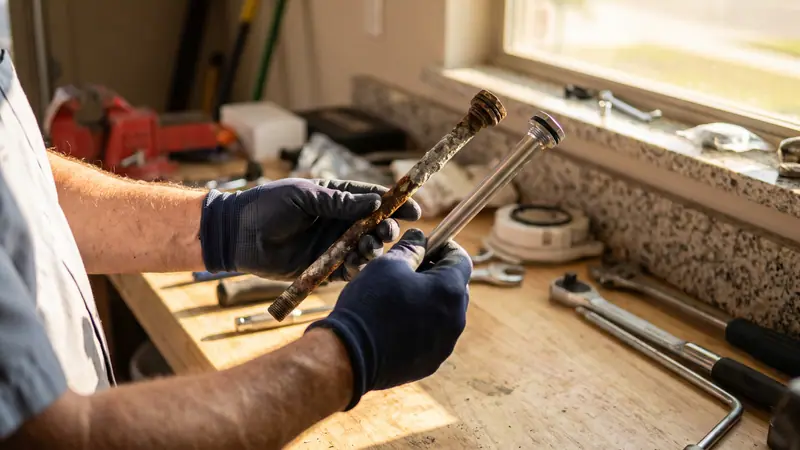
Inside every tank water heater is a sacrificial anode rod — a magnesium or aluminum rod suspended in the water. Its entire job is to corrode so your tank doesn’t. Through basic electrochemistry, the rod attracts the corrosion that would otherwise eat through the steel tank walls. When the rod is used up, the tank starts dissolving instead. From that point, tank failure isn’t an if — it’s a when.
Here’s why this matters so much locally. Water hardness across the NE San Antonio metro commonly tests at 14–15+ grains per gallon — the Edwards Aquifer flows through limestone, and all that dissolved calcium and magnesium comes along for the ride. In water this hard, an anode rod that should last 4–5 years can be consumed in 2–3. Combine an exhausted anode rod with a thick blanket of scale sediment on the tank bottom, and you get the pattern we see constantly on service calls: tanks failing at year 7 or 8 that should have made it to 11 or 12. Hard water reliably cuts 2–4 years off water heater lifespan in this area.
The fix is almost embarrassingly cheap: have the anode rod checked every 2–3 years and replaced when it’s mostly consumed. A rod costs $30–$60; a replacement tank costs $1,400–$2,600 installed. If you do only one maintenance task from this article, make it this one. And if you want to attack the root cause, a water softener protects the heater and everything else in the house.
When to Replace a Water Heater: 7 Warning Signs
Age alone doesn’t condemn a heater, but these signs tell you the clock is running out. Knowing when to replace water heater equipment — before it fails — is the difference between a planned Tuesday install and a flooded garage on a holiday weekend.
- It’s 10+ years old. Check the serial number on the manufacturer’s label — the first four digits usually encode month and year. Past age 10, every year is borrowed time for a tank unit in hard-water territory.
- Rusty or brown hot water. If only the hot side runs discolored, the tank is corroding from the inside. This one is close to a death sentence.
- Rumbling, popping, or banging sounds. That’s water flashing to steam beneath a layer of scale on the tank bottom. It means heavy sediment, overworked steel, and wasted gas or electricity.
- Moisture or drips around the base. Condensation is sometimes innocent; a slow weep from the tank body is not. See our guide on what to do when a water heater is leaking — and know that a leaking tank body cannot be repaired.
- Running out of hot water faster than you used to. Sediment displaces capacity — a 50-gallon tank with 8 gallons of scale in the bottom is a 42-gallon tank that costs more to run.
- Repairs are stacking up. One repair on a 6-year-old unit is normal. Two repairs in two years on a 10-year-old unit means stop feeding it parts.
- Metallic-smelling or -tasting hot water. Often the anode rod is gone and the tank walls are next.
Two or more of these at once — especially on a unit past year 8 — and you should be pricing replacement on your terms. Our water heater replacement cost guide breaks down exactly what to budget in 2026.
Maintenance That Actually Extends Water Heater Lifespan
You can’t change the water, but you can change what it does to your equipment. In rough order of impact:
Flush the tank once a year
Hook a garden hose to the drain valve, run it to a floor drain or driveway, and flush until the water runs clear. In NE San Antonio metro water, annual flushing is not optional if you want to reach double-digit years. Twice a year is even better here.
Check the anode rod every 2–3 years
Covered above, and worth repeating: it’s the cheapest lifespan extension available. If the rod is more than 75% consumed or the steel core wire is exposed, replace it.
Test the T&P relief valve annually
Lift the lever briefly and make sure water discharges and the valve reseats. A stuck valve is a safety issue, and a constantly weeping one wastes water and hints at pressure problems.
Keep the temperature at 120°F
Hotter settings accelerate scale formation and tank stress (and scald risk). 120°F is the sweet spot for safety, efficiency, and longevity.
Descale tankless units annually
If you own a tankless unit anywhere in the San Antonio metro, an annual vinegar or descaler flush of the heat exchanger is mandatory maintenance — most manufacturers require it in writing to honor the warranty in hard-water areas.
Consider a water softener
Every item above gets easier — and some become nearly unnecessary — with softened water. It’s the only fix that addresses the cause rather than the symptoms, and it protects your dishwasher, washing machine, faucets, and pipes at the same time. Learn more about water softener installation.
One Texas-specific note: protect it during freezes
After the February 2021 Uri freeze and the January 2026 arctic outbreak, plenty of area homeowners learned that garage and attic water heaters — and the exposed pipes feeding them — are vulnerable in hard freezes. Insulate the lines, and during multi-day freeze events keep the garage door closed and let faucets drip. A freeze-burst fitting at the heater can flood a garage as effectively as a failed tank. If a hard freeze does damage your unit, our water heater repair team can tell you quickly whether it’s fixable.
The Bottom Line
A water heater in the NE San Antonio metro lasts as long as you let it. Neglected, a gas tank here gives you 6–9 years. Flushed annually, with an anode rod swap or two — or backed by a softener — the same unit reaches 10–13. If yours is already past year 10, don’t wait for the failure: start planning the replacement while it’s still a choice and not an emergency.
Need help in the San Antonio area?
Whether your water heater needs an anode rod check, a repair, or it’s simply reached the end of the road, Hill Country Plumbing Pros serves Schertz, Cibolo, Universal City, New Braunfels, and the surrounding NE San Antonio metro with honest assessments and upfront pricing. Call (210) 555-0199 or learn more about Water Heater Replacement in San Antonio.